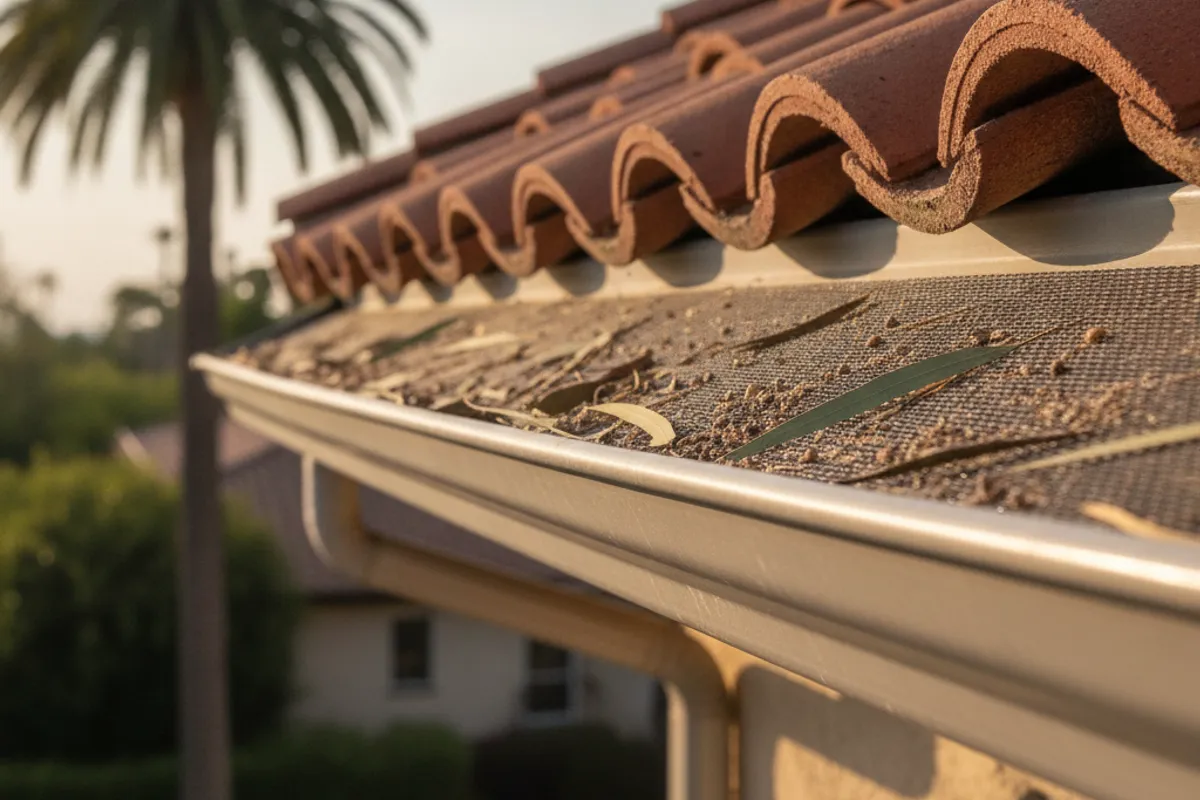
Gutter guards can reduce how often you clean your gutters, but they do not eliminate cleaning entirely, and the right type for your home depends heavily on what is falling off your roof. Here is what to consider before spending $1,500 or more on a guard system.
What San Diego gutters actually deal with
The debris profile here is different from wetter climates. San Diego does not get heavy leaf fall in autumn the way northern California does. What clogs local gutters most often is:
- Eucalyptus debris: seed pods, bark strips, and long narrow leaves that can work through screens and pack tightly in corners
- Palm fronds and seed clusters: heavy, fibrous, and capable of bridging over guards entirely
- Pine needles: common in higher-elevation neighborhoods like Rancho Bernardo and Poway, and notorious for piercing micro-mesh
- Dry season dust and granules: asphalt shingles shed granules year-round, and they wash into gutters during the first rains, eventually silting up any system
The marine layer also means gutters stay damp longer than they would in a drier inland climate, which accelerates oxidation and encourages mold growth inside the channel.
The main gutter guard types
Screen guards are the least expensive option, typically $0.50 to $2.00 per linear foot installed. They stop large debris but let in smaller material. In most San Diego yards, they slow cleaning but do not stop it.
Reverse-curve (surface tension) guards redirect water around a curved nose into the gutter while debris is supposed to fall off. They struggle with fine debris and can overflow in heavy rain if the curve is not matched to your roof pitch.
Foam inserts sit inside the channel and block debris from entering. They work initially but trap organic material and can become a moss and mold problem over time, particularly in coastal neighborhoods where humidity lingers.
Micro-mesh guards are the highest-performing type in most San Diego conditions. A fine stainless steel mesh allows water through while blocking most debris. Installed cost ranges from $3 to $8 per linear foot for quality products. They are not impervious to pine needles or shingle granules, but they reduce cleaning frequency meaningfully.
When guards make sense and when they do not
Guards are more likely to pay off if:
- You have a high or steep roof where ladder access is genuinely dangerous
- You are surrounded by eucalyptus or pine trees that shed continuously
- You have a two-story home where professional cleaning runs $200 or more per visit
Guards are a harder sell if:
- Your yard has minimal tree coverage
- Your gutters are sectional with many seams (guards will not fix leaks at the joints)
- Your fascia or gutter hangers are already failing (install new gutters first)
What they cost to install
Installed prices for micro-mesh systems in San Diego County typically run $1,500 to $3,500 for an average single-story home. Verify any contractor at cslb.ca.gov before signing. High-end brand systems sold door-to-door often cost significantly more. Before committing to any installed system, get at least two competing quotes.
The honest answer
Quality micro-mesh guards reduce cleaning frequency for most San Diego homes, but do not buy into any claim that they are “maintenance-free.” You will still need to inspect and flush gutters after fire season or a major Santa Ana wind event.
If your primary motivation is safety because you do not want to get on a ladder, guards combined with a professional cleaning once a year are a reasonable investment. If your goal is zero maintenance, no guard achieves that in San Diego’s debris environment.
Gutter Works SD connects homeowners with insured contractors who can assess your specific roof, tree coverage, and gutter condition before recommending a guard type. Call (858) 925-5546 or submit a request online for a no-cost referral. See our gutter guard installation page for details.