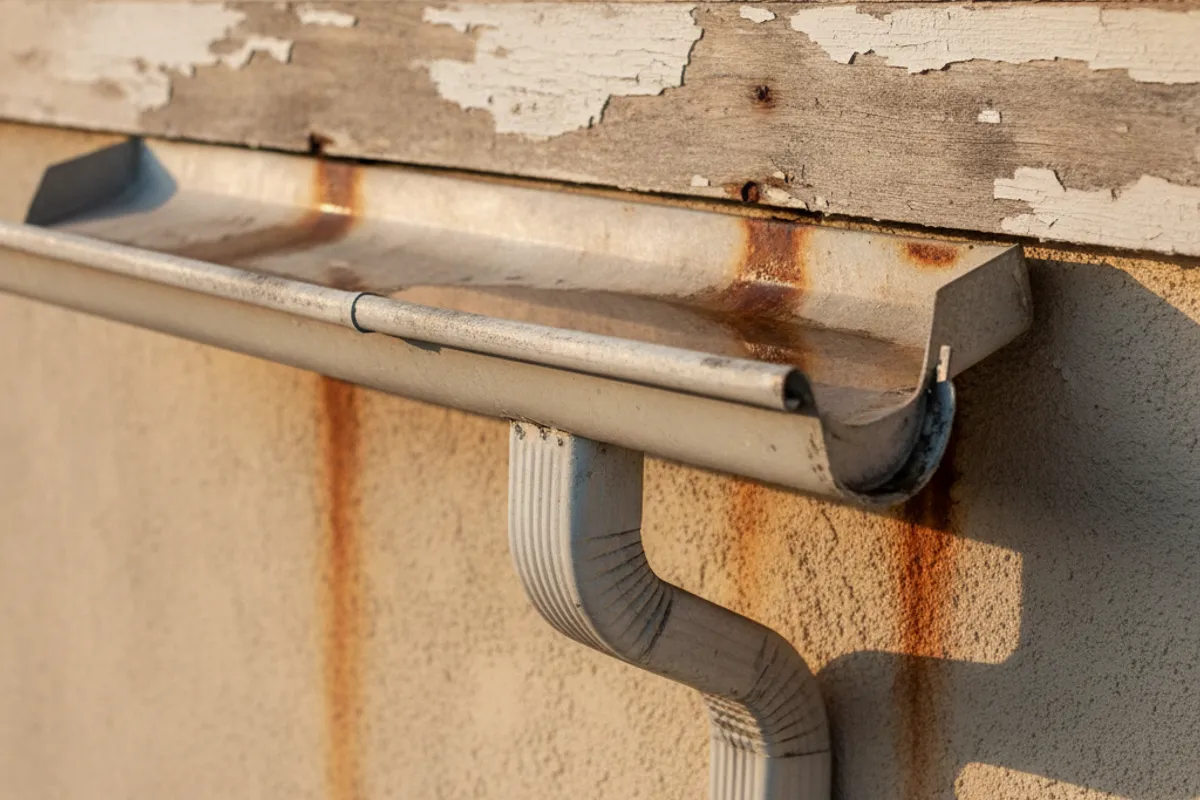
Most San Diego homeowners do not think about their gutters until something visible goes wrong. By then, the gutter may have been failing quietly for months, and the damage may have already extended to the fascia, soffit, or foundation. Knowing what to look for lets you get ahead of it.
Water overflowing the gutter face during rain
This is the most visible sign, and it has two possible causes. The gutter is clogged and needs cleaning, or the gutter is pitched incorrectly or sagging so water pools in the channel instead of flowing toward the downspout. A clog is a maintenance issue. Sagging or incorrect pitch is a structural issue that often means the gutters need replacement.
If you clean the gutters and water still overflows in the same section during the next rain, the gutter itself is the problem.
Gutters pulling away from the fascia
Gutters are hung from spikes driven into the fascia or from hidden hangers screwed into the rafter tails. When the gutter sags or gaps appear between the back of the gutter and the fascia, one of three things is happening: the hanger spacing is too wide and the system is flexing under load, the hangers have pulled out of rotted fascia, or the gutters themselves have deformed from age and debris weight.
A gap of more than a quarter inch between the gutter back and fascia, visible when you look along the roofline, is a sign the system is failing. Rehanging is sometimes possible, but only if the underlying fascia is sound.
Visible cracks, splits, or holes
Cracks most often appear at gutter seams where caulk has dried out and failed. Small cracks can be re-caulked and patched as part of routine maintenance. Long cracks running down the body of the gutter section, or holes, generally mean the metal has corroded through and the section needs replacement.
Sectional aluminum gutters are more prone to this because the seams are where corrosion concentrates. Rust on steel gutters, or white oxidation powder on aluminum, indicates the coating has been compromised and moisture is attacking the base metal.
Peeling paint or staining on the fascia and siding
Paint peeling along the fascia directly behind the gutter is almost always a moisture sign. Either the gutter is overflowing and running down behind it, or the gutter is sitting with standing water that wicks onto the fascia over time. Left unaddressed, this becomes fascia rot.
Dark staining on the siding below the gutter line suggests the gutter has been overflowing at that point repeatedly. Even one or two seasons of overflow can stain exterior siding significantly.
Water pooling at the foundation after rain
If water is pooling against your foundation or in a low spot adjacent to the house after rain, the gutter system may not be draining effectively. This could be a downspout clog, an undersized downspout, or a discharge point that terminates too close to the foundation. San Diego’s clay-heavy soils in areas like Chula Vista and El Cajon do not absorb water quickly, making proper drainage especially important.
Gutters more than 20 years old
Aluminum gutters installed more than 20 years ago may be approaching the end of their practical life even if they do not show obvious visible failure. If you have multiple small issues appearing simultaneously, including minor leaks at several seams, isolated sagging, and paint wear, it is often more cost-effective to replace the system than to keep patching it.
Repair or replace
A single cracked seam or a section that has pulled from the fascia in one spot does not necessarily mean full replacement. Isolated repairs can extend gutter life by several years.
Full replacement makes more sense when the system has widespread issues, when the fascia behind the gutters needs repair anyway, or when the gutters are an older sectional system with many leak-prone seams.
Gutter Works SD connects San Diego County homeowners with insured, pre-screened gutter contractors who can assess your system and give you an honest repair-vs-replace recommendation. Verify any California contractor’s license at cslb.ca.gov. Call (858) 925-5546 or request a referral online. See our gutter repair page to understand what repairs cover.