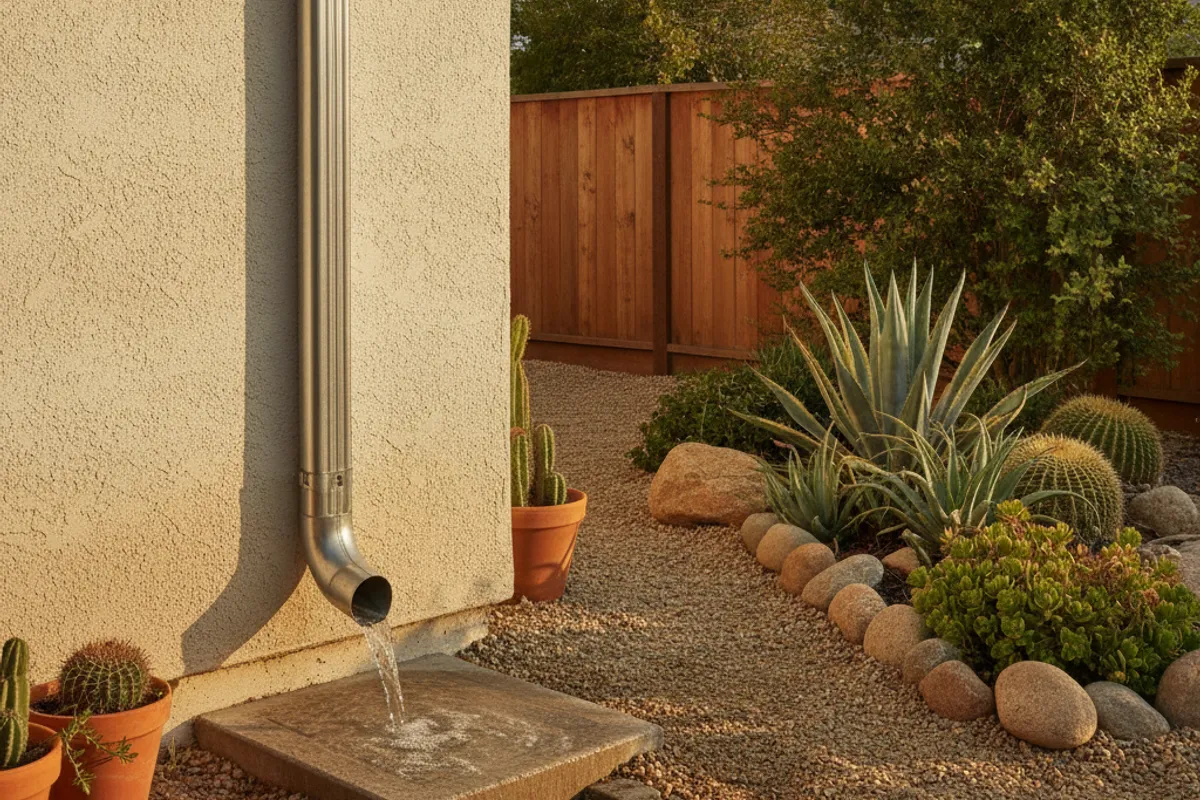
Getting water off your roof is only half the job. Where it goes after it leaves the downspout determines whether your gutters are actually protecting your home or just moving the problem from the roofline to the foundation.
How many downspouts a gutter run needs
A general rule in the industry is one downspout for every 30 to 40 linear feet of gutter. A 120-foot gutter system would typically have three to four downspouts. That said, the correct number also depends on your roof’s drainage area, pitch, and how much rain your gutters need to handle during a storm event.
San Diego’s rainfall is concentrated in a short window, typically November through March, with individual storms sometimes delivering an inch or more in a few hours. Undersized or under-drained gutter systems that handle light drizzle fine can overflow dramatically during a bigger event. If your gutters are pulling away from the fascia after heavy rain, insufficient downspout capacity is often the reason.
Where to place downspouts
Downspouts should terminate as far from the foundation as practical, ideally at least five feet away, and should direct water toward a surface that absorbs it or channels it away from the structure.
Good discharge points include:
- A sloped lawn or planting bed that grades away from the house
- A dry creek or swale that carries water toward the street
- Underground downspout extensions that tie into a French drain or pop-up emitter in the yard
- A rain barrel or cistern for captured reuse (more on that below)
Poor discharge points include:
- Directly against the foundation or into a window well
- Onto a neighbor’s property
- Into a drainage swale or storm drain not designed to receive concentrated discharge (San Diego County has rules about this)
San Diego drainage regulations
San Diego County and its municipalities are part of the Municipal Separate Storm Sewer System (MS4) permit area. Discharging concentrated runoff onto neighboring properties or directly into storm drains in ways that cause erosion or carry pollutants can result in code enforcement action. If you are tying downspouts into an underground drainage system that eventually connects to the street or a storm drain, consult with your contractor about compliance.
The City of San Diego’s Development Services Department handles drainage-related permits. For properties in unincorporated areas, contact San Diego County’s Department of Planning and Development Services.
Splash blocks and extensions
The simplest discharge method is a splash block, a sloped concrete or plastic block placed under the downspout outlet to disperse water and direct it away from the foundation. They cost a few dollars and are effective when the grade naturally carries water away from the structure.
Flexible or rigid downspout extensions, sometimes called “accordion extenders,” add additional length to push the outlet further from the wall. These are inexpensive and work well for simple situations, though they can be tripped over and are not ideal for high-traffic areas.
Underground pop-up emitters are cleaner and more permanent. A buried PVC pipe runs from the downspout outlet under the landscape and terminates at a pop-up valve in the yard. Under pressure from runoff, the valve opens and releases water. When the rain stops, it closes, keeping out pests. Installed cost typically runs $150 to $350 per downspout run depending on length.
Grading and foundation considerations
Even perfectly placed downspouts can cause problems if the grade around your foundation has settled or was never properly established. San Diego’s expansive clay soils, common in areas like Chula Vista and El Cajon, can heave and shift over time, creating low spots that pool water against the foundation slab or stem wall.
If water is consistently pooling near your foundation after rain, the issue may require re-grading rather than, or in addition to, gutter work. A gutter contractor can assess downspout placement, but persistent foundation-adjacent pooling should also be evaluated by a drainage or grading specialist.
Getting the system designed correctly
Downspout count, placement, and discharge method should be part of any gutter quote conversation, not an afterthought. Ask each bidding contractor where they intend to terminate every downspout and why.
Gutter Works SD refers San Diego County homeowners to insured, pre-screened gutter contractors who can assess your specific drainage situation. Call (858) 925-5546 or request a referral online. Learn more about our downspout installation service.