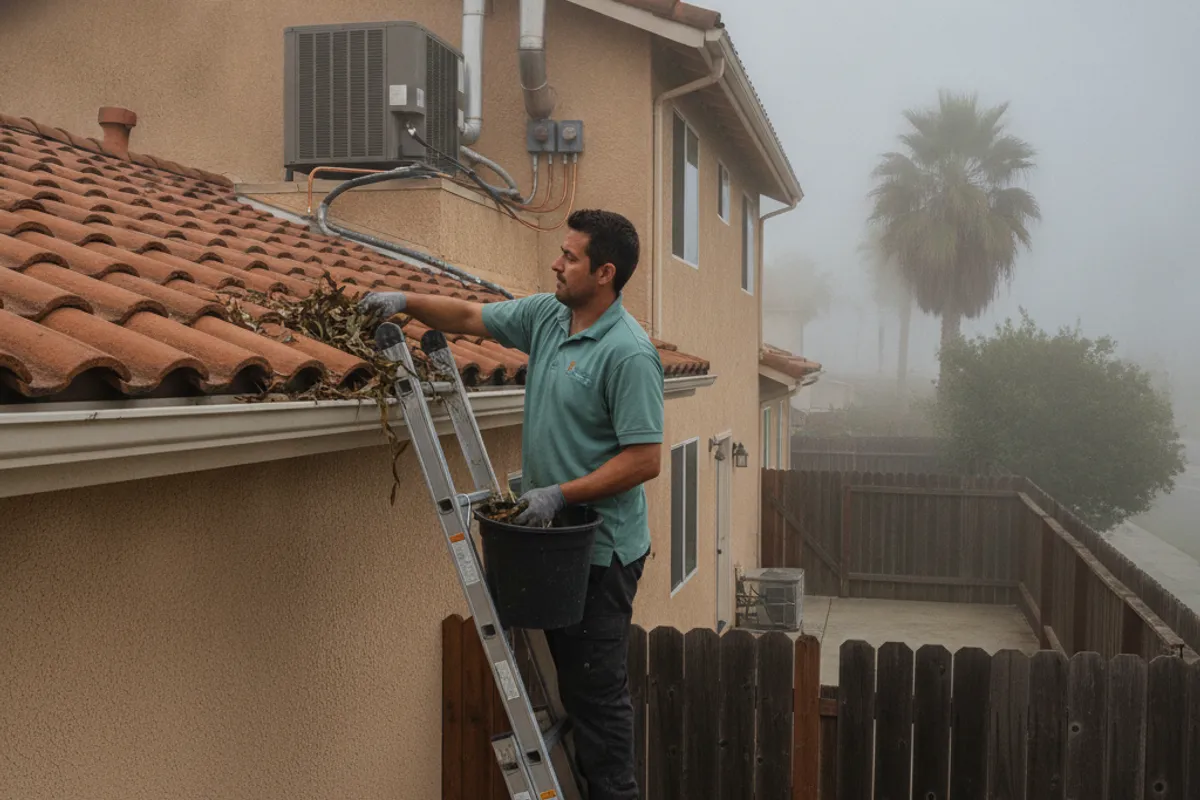
San Diego’s climate is mild enough that many homeowners assume their gutters can go indefinitely without attention. That assumption is wrong, and the marine layer is one reason why.
What makes San Diego gutters different
The classic gutter-cleaning advice is to clean twice a year: once after fall leaves drop and once in spring. That schedule was written for regions that get true autumn leaf fall and significant annual rainfall. San Diego’s situation is different in three ways.
Debris type: San Diego’s most common street trees are eucalyptus, palms, and pines rather than deciduous hardwoods. Eucalyptus sheds bark, seed pods, and narrow leaves year-round rather than in one autumn burst. Palm seed clusters are heavy and can wedge into gutters and downspout openings. Pine needles accumulate steadily in neighborhoods like Rancho Bernardo, Poway, and Scripps Ranch.
Dry season buildup: The long dry season, typically May through October, allows debris to accumulate in gutters without rain to flush it out. By the time the first significant rains arrive in November or December, gutters can be packed with months of dry material that then absorbs water, gets heavy, and pulls hangers away from the fascia.
Marine layer moisture: The marine layer that settles along the coast from roughly Pacific Beach north through Oceanside keeps metal surfaces damp overnight and into the morning. That persistent moisture accelerates the breakdown of any organic material sitting in the gutter, including seed pods, bark, and shingle granules. A clogged gutter in a marine-layer neighborhood grows mold and mildew faster than one in a drier inland area like El Cajon or Lakeside.
A practical cleaning schedule
Homes with significant tree coverage (eucalyptus, pine, or palm within 30 feet of the roofline): Clean three times per year. Once in late summer before fire season ends, once in early November before the rains start, and once in February after the heaviest rain months.
Homes with moderate tree coverage or in suburban neighborhoods with mixed landscaping: Clean twice per year. Once in October before the rainy season and once in March or April after it ends.
Homes with minimal tree coverage and open rooflines: Once per year in October is typically sufficient. Inspect in spring to confirm.
After significant events: Clean or at least inspect after a major Santa Ana wind event, which can fill gutters with dry debris rapidly, and after any fire season smoke event, which deposits fine ash that can combine with water to form a paste that clings to gutter walls.
Signs your gutters need cleaning now, regardless of schedule
- Water spills over the gutter face during rain rather than flowing to the downspout
- Gutters are sagging or pulling away from the fascia (often a sign of water weight from a clog)
- Plants are visibly growing from the gutter channel
- Downspout drains slowly or not at all when you pour water in from the top
- Staining on the siding or fascia directly below a gutter section
Why timing before the rainy season matters most
In San Diego, the most important cleaning of the year is the one you do before November. A clean gutter entering the rainy season flows freely through whatever storms arrive. A clogged gutter entering the rainy season can overflow onto the fascia, saturate it, and cause wood rot that costs far more to fix than a cleaning would have.
If you do only one cleaning per year, do it in October.
Gutter Works SD refers San Diego County homeowners to insured, pre-screened gutter and gutter-cleaning contractors. Call (858) 925-5546 or request a referral online to find a contractor who serves your neighborhood. See our gutter cleaning page for more.