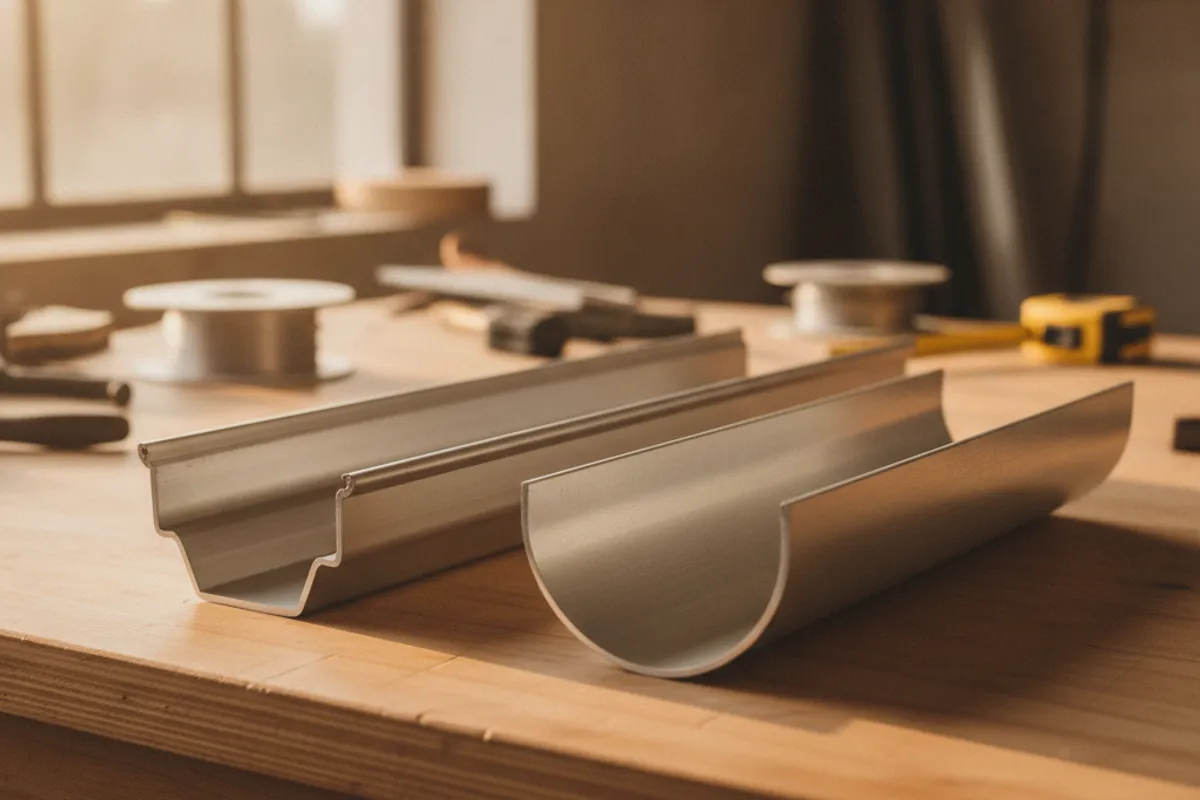
When most people picture a rain gutter, they are picturing K-style. It is what you see on the majority of houses built in the United States after about 1950. Half-round gutters are older and less common, but they remain a meaningful option for specific homes and situations. Here is how they compare.
K-style gutters
K-style gutters have a flat back that mounts against the fascia, a flat bottom, and a decorative front profile that somewhat resembles crown molding when viewed in cross-section. The “K” designation comes from the profile shape, not any functional property.
The flat back and bottom make K-style easy to mount against a standard vertical fascia without custom hardware. They are structurally stiff, which means longer runs between hangers are possible without sagging. They are also available in more color options than half-round and are the standard for seamless aluminum fabrication.
Capacity is a real advantage. A 5-inch K-style gutter handles more water volume than a 5-inch half-round because the flat bottom gives it a larger cross-sectional area. In San Diego, where storms are infrequent but can deliver rain quickly, capacity matters during the intense events.
Standard widths are 4-inch, 5-inch, and 6-inch. Most residential installations in San Diego use 5-inch for single-story and 6-inch for two-story or large-roof-area situations.
Half-round gutters
Half-round gutters are a semicircular trough. They were the standard profile for most of the 20th century before K-style displaced them. Many older homes, craftsman bungalows, Spanish colonial revivals, and Tudor-style houses were built with half-round as part of the original design.
The curved interior of a half-round gutter has no corners where debris can accumulate, which gives it a slight advantage in self-cleaning during rain. Water flows more smoothly through a half-round because there are no interior angles to create turbulence.
Half-round gutters are typically mounted with exposed round fascia brackets, which contribute to the period aesthetic. The exposed hardware looks intentional on an older home; on a modern home it can look out of place.
They are also the standard profile for copper gutters, because copper half-round paired with round copper downspouts is the traditional combination that looks appropriate on period architecture.
Half-round is less common in seamless aluminum fabrication, though it is available from contractors who carry the appropriate roll-forming die.
Which to choose
K-style is the right choice for most contemporary San Diego homes built after 1960 and for any home where the primary goal is functional drainage at a reasonable cost. It is more widely available, faster to fabricate seamlessly, and typically costs slightly less per linear foot than half-round.
Half-round is worth considering for older homes where the profile matches the original architectural intent, or where the owner is installing copper and wants the traditional aesthetic. It is also a reasonable choice for any homeowner who prefers the look of the curved profile over the flat-bottomed K-style, regardless of home age.
If you are replacing gutters on a craftsman in North Park or a Spanish-style home in Mission Hills, the architectural context is worth a conversation with your contractor about which profile fits the house.
Cost difference
In aluminum, K-style and half-round are often priced similarly per linear foot installed, though half-round may run $1 to $2 per foot more due to slightly higher material cost and less common fabrication equipment. In copper, both profiles are priced at the same installed rate since copper half-round and round downspouts are the standard combination.
Gutter Works SD refers San Diego County homeowners to insured, pre-screened gutter contractors who work in both profiles and materials. Verify any California contractor’s license at cslb.ca.gov. Call (858) 925-5546 or request a referral online. Compare K-style gutters and half-round gutters on our services pages.