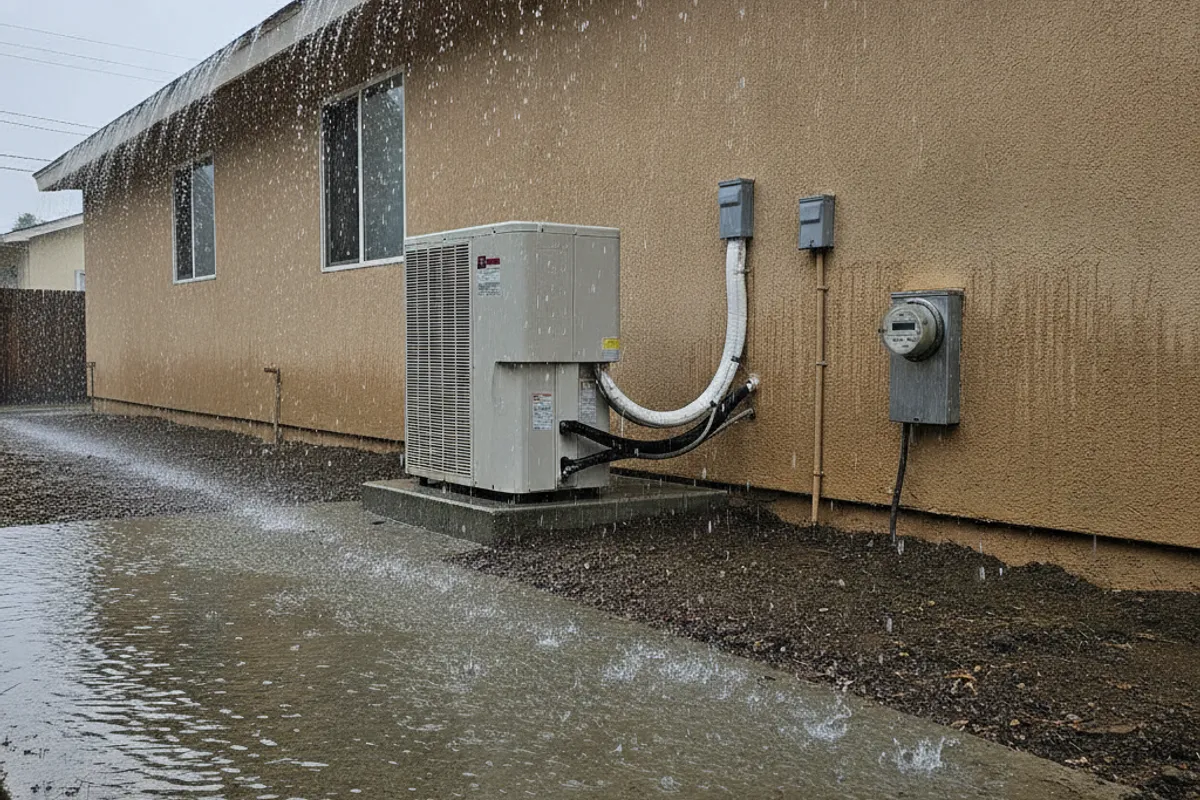
San Diego does not get the kind of sustained rainfall that wetter climates deal with, but that does not make roof runoff a minor concern. A home without gutters, or with gutters that dump water directly adjacent to the foundation, concentrates roof drainage into a small area near the structure’s base. Over years, that repeated saturation can do real damage.
What roof runoff does to a foundation
When rain hits your roof, the surface area of the roof concentrates it and accelerates it off the eaves. Without gutters, water falls in a line directly below the roofline, often just a few feet from the foundation. On a 2,000-square-foot home, even a half-inch of rain moves a significant volume of water off the roof.
The two main mechanisms of foundation damage from runoff are:
Soil saturation and expansion: San Diego’s soils vary by area, but expansive clay soils are common in many neighborhoods, particularly in Chula Vista, Spring Valley, El Cajon, and parts of Escondido. Clay soils expand when wet and contract when dry. Repeated saturation cycles over years can cause differential movement in the foundation, which shows up as cracking in the slab, sticking doors and windows, and cracks in interior drywall.
Erosion at the footing: Water falling directly off the eaves erodes the soil immediately adjacent to the foundation footing over time. In a worst case, this can undermine the footing and create settling.
The role gutters play
A properly functioning gutter system collects water from the entire roof surface and routes it to downspouts that are positioned to discharge water away from the foundation. Instead of a line of concentrated drip-off along the eaves, the water is channeled to controlled discharge points.
The key word is “away.” A gutter that drains into a downspout that terminates two inches from the foundation accomplishes very little. The downspout needs to discharge at least five feet from the foundation, ideally through an extension or underground pipe to a discharge point further out in the yard.
Grading matters as much as gutters
Gutters and downspouts are only one part of the equation. The grade of the soil around your foundation determines where water goes after it hits the ground. The general standard is that soil should slope away from the foundation at approximately one inch per foot for the first six feet from the structure.
Many San Diego homes have grade issues that developed over years of landscaping, erosion, and soil settlement. Mulch beds built up against the house, concrete walkways that have sunk and now slope toward the structure, and backfill that has compacted away from the foundation wall are all common problems.
If you correct your gutter drainage but the grade still directs water back toward the foundation, you will continue to have moisture issues.
Signs water is already reaching your foundation
- Cracking in the exterior finish at or near the foundation line
- Efflorescence (white mineral deposits) on concrete block or masonry near the base of the wall
- Damp smell in a crawl space or on the interior of a below-grade wall
- Soil that is consistently muddy near the foundation long after rain has stopped
- Interior doors or windows that stick in winter and free up in summer (can indicate seasonal foundation movement)
What to do if you are already seeing these signs
Start with the gutters and downspouts. Confirm they are clean, functional, and discharging water well away from the structure. If gutters are missing entirely, that is the first repair.
Then assess the grade. A landscaper, grading contractor, or drainage specialist can evaluate whether the soil slope is directing water away from or toward the foundation.
If you have already had water intrusion or notice structural symptoms like cracking or differential settling, a geotechnical or foundation engineer should be consulted. Gutters and grading are preventive measures; they are not remediation for an already-compromised foundation.
Gutter Works SD
Gutter Works SD is a referral service. We connect San Diego County homeowners with insured, pre-screened gutter contractors who assess drainage as part of the installation conversation, not as an afterthought. Verify any contractor’s California license at cslb.ca.gov.
Call (858) 925-5546 or request a referral online. See our downspout installation service for proper drainage solutions.